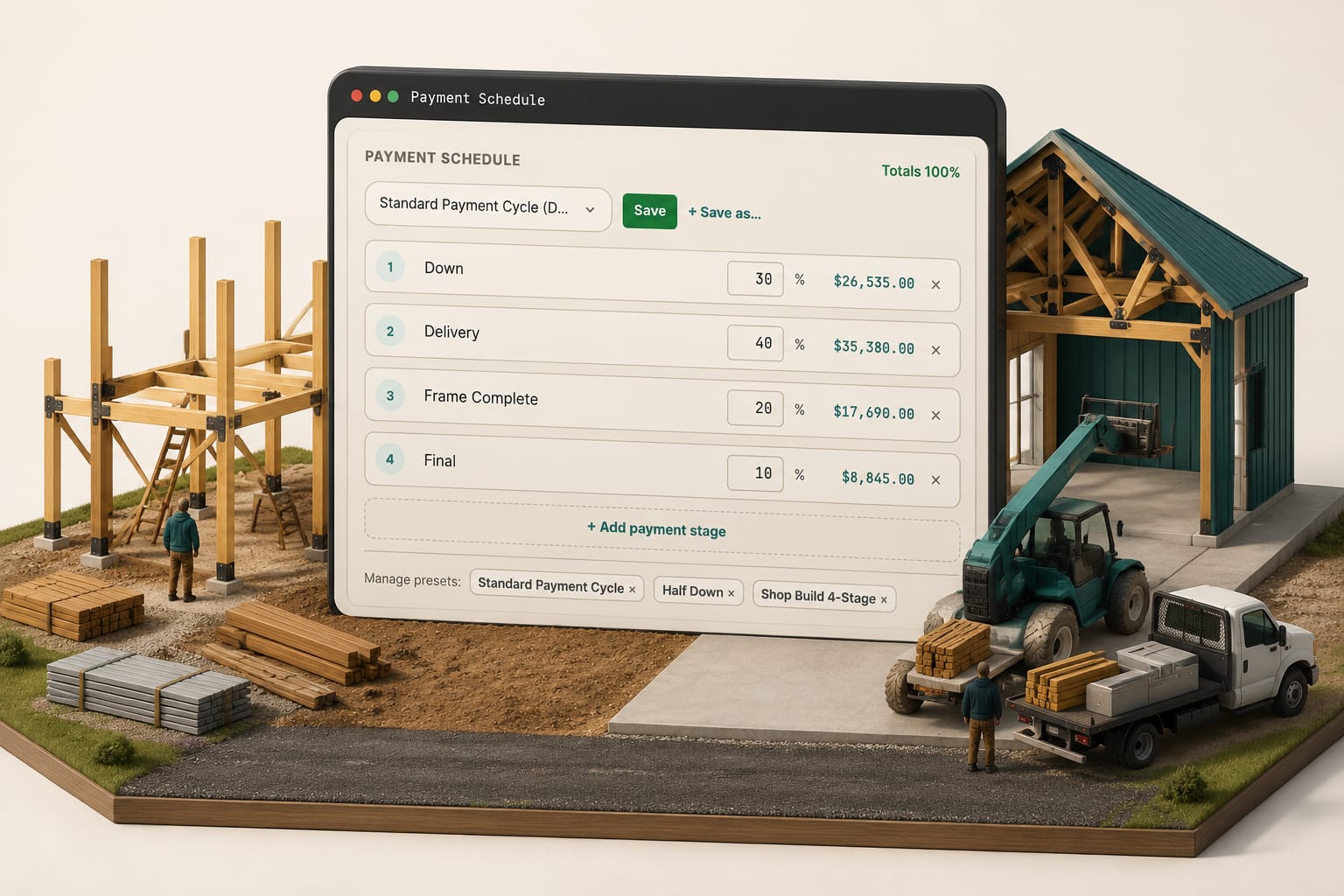
The short answer: A barndominium draw schedule splits the contract price into a deposit, stage draws (slab, shell, rough-ins, finishes) and a final, written on the estimate the customer approves and carried into the contract unchanged. Each draw becomes an invoice the day its stage is earned, so you bill what was agreed, and the lender's inspector checks the same stages you bill.
A construction draw schedule that lives in the project manager's head is a loan you did not mean to make. A payment schedule is the agreed split of the contract price into a deposit, one or more draws and a final, written on the estimate the customer approves, carried into the contract unchanged, and turned into an invoice as each stage is earned. It is the difference between billing what was agreed and trying to remember what was said.
How to set one up and turn it into invoices is on the payment schedule feature page.
What a payment schedule is: deposit, draws, final
A payment schedule is three or more dated promises attached to one price. On an $86,000 40x60 shop with 14-foot walls, a 30/40/30 schedule reads: $25,800 on signing, $34,400 when the material lands on the pad, $25,800 when the last trim piece is on. Each line has an amount, a trigger and a status: not yet due, sent, paid.
Two shapes cover nearly every post-frame job:
- Percentages for the standard shop, garage or hay barn. 30/40/30, 50/50, or 25/25/25/25. The customer reads a fraction and understands it.
- Fixed dollar draws for the barndominium with a lender behind it. The bank releases money against named events, so the draws are named dollars against named events: $60,000 at dried-in, $45,000 at rough-in, and so on.
Why the schedule belongs on the quote, not on the phone
The moment to agree the money is the moment the customer is agreeing the price. A schedule stated on the quote, approved with the quote and carried into the agreement unchanged is the one that never gets argued about at the delivery draw. A schedule agreed on the phone after signing is a negotiation you have to win a second time, with the trusses already ordered.
There is a compliance reason too. Several jurisdictions cap what you may take before work starts. California's Contractors State License Board states that on a home improvement contract the down payment must not exceed 10 percent of the contract price or $1,000, whichever is less. Your state or province has its own rule. A schedule written on the quote is the only version of your terms you can point to when someone asks whether you followed it.
Why post-frame needs draws more than most trades
A post-frame job is front-loaded with material in a way a framing crew's job is not. The posts, the truss package and the steel are ordered, delivered and invoiced to you by the yard before most of the labour has happened. If your delivery draw is not billed the day the truck leaves the pad, you are carrying the yard's invoice on the customer's behalf until somebody remembers.
Weather makes it worse. A two-week rain delay after delivery slips the dried-in stage, and a schedule tied to calendar dates slips the draw with it, even though the material is already sitting on site paid for by you. Tie draws to events, not dates: delivery, dried-in, completion. The build schedule tells you when a stage is actually finished; the payment schedule is what that finish is worth.
What "each stage becomes an invoice" means for the office
Once the schedule is agreed, the office is not deciding what to bill. It is billing what was agreed, when the trigger is met. The delivery draw on the 40x60 is $34,400 because the customer signed a page that said $34,400; the invoice is a copy of that line, not a fresh calculation. That is an easier email to send and an easier one to receive, and it is why invoicing built off a schedule draws fewer questions than invoicing built off a spreadsheet: the customer has already read the line.
If you are still writing draws by hand, the contractor invoice template that actually gets paid shows what the line has to carry. Inside contractor management software those fields are already filled from the schedule.
What happens when the job changes mid-build
Two things move a schedule after signing, and they must not touch what has already been billed.
- A change order. The customer adds a 12-foot lean-to at week three. The extra adjusts the stages still to come, or rides as its own bill, and the two draws already paid stay exactly as they were. A schedule that quietly rewrites paid draws becomes fiction halfway through the job. Pricing the extra so it protects margin is covered in the construction change order that protects your margin.
- Estimate drift. Somebody edits the estimate after signature and the total creeps. The schedule bills the signed number and says so, naming both figures and the difference, rather than silently billing the new one.
The customer can see it the whole time
The schedule is on the quote they approved, in the agreement they signed, and on their project page as the build runs, with paid draws folded away and the next one due at the top. Customers who can see what they have paid and what is next stop ringing to ask, which is the argument made in why contractor management software needs a live customer page. The whole run from quote to that page is the Live Estimate System.
Who a payment schedule fits, and who it does not
It fits any builder who bills a job more than once. That is nearly every post-frame company: the shop over three weeks with a deposit and two draws, the riding arena with four, the barndominium with a lender's six.
It fits the kit supplier too, in a smaller way: deposit on order, balance on delivery is a two-line schedule, and it still stops the balance being forgotten.
It is not much use for a builder paid in full up front on small jobs, or for the company whose lender dictates the draw form so completely that the builder never bills a customer directly. Both can write the schedule for the record, but the invoices will not come off it.
What the research says
- Banks pay against paper, not against the building. A construction lender writes that residential loans usually carry 4 to 6 milestone draws, with 2 to 5 business days for the inspection and 2 to 3 more to fund, and that missing lien waivers are the top cause of a held draw. Change orders that are not in the budget hold draws too. A schedule that matches the lender's stages keeps the barndo's money moving.
- The lender wants the schedule before the job starts. A national barndo lender asks for plans, specs and a line-item builder budget with a contingency, verifies each draw by inspection, and typically closes 30 to 45 days after the file is complete. A draw schedule written on the estimate is part of that file, not paperwork you build later.
- Paying hurts least when it was planned. In Prelec & Loewenstein's model of the pain of paying, people feel the cost at the moment they pay, and they prefer payment arrangements they can account for ahead of time, which is why known, flat prices appeal even when they cost more. A draw the customer agreed to on the estimate is already in their budget; a figure remembered from a phone call arrives as a fresh hit.
- Late money comes out of the builder's pocket. In a vendor survey of 503 construction firms, 39% waited 30 days or more even after an invoice was approved, and 34% dipped into personal savings or credit when paid late. Mostly commercial trades, but the builder who floats a barndo between draws knows the feeling.
- Bill as earned, never ahead. California's contractor board says progress payments can't run ahead of the work done on home-improvement contracts. Rules vary by state, but a draw tied to a finished stage is the version that holds up everywhere.
Before you write the next one
- Decide your default shapes: one percentage schedule for shops and barns, one fixed-dollar schedule for financed homes.
- Tie every draw to an event you can prove: signing, delivery, dried-in, completion. Never a calendar date.
- Check your state or province's deposit cap and set the first line under it.
- Save the shapes as presets so the right one lands on the quote without being chosen.
- Agree the schedule on the quote. If the customer wants it changed, change it there, before they approve.
What the schedule does not do is chase. It tells you what to bill and when, and it tells the customer what is due. A customer who lets the delivery draw sit for three weeks still has to be phoned by a person, and how often to phone before it becomes a lien question is a decision the software does not make for you.