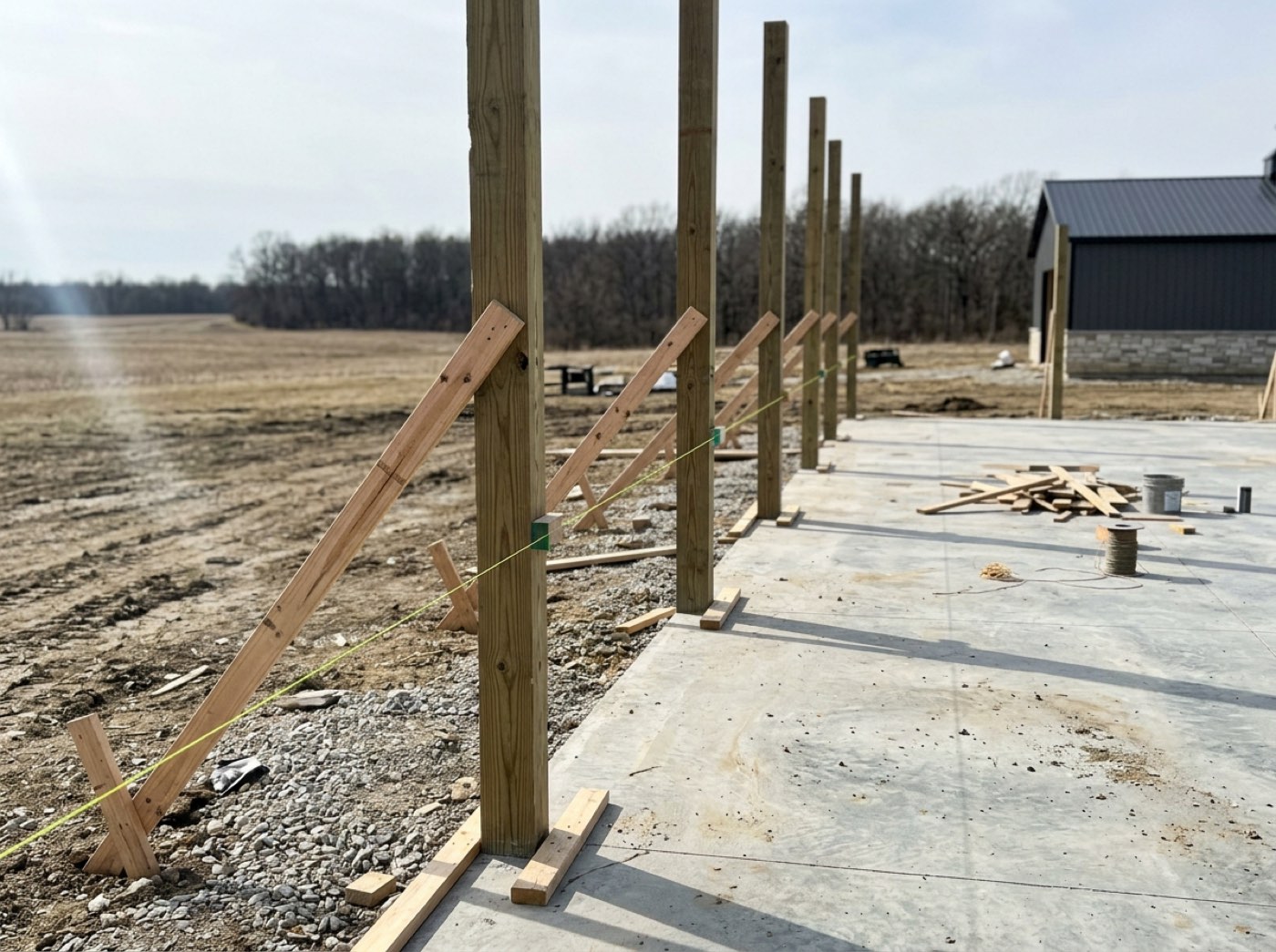
The Launch Pad
Nothing starts half-ready: one step turns the signed deal into a scheduled job, the crew accepts the job and the pay on their phone, the subs bid and sign a purchase order for their stage, and the material order goes to the yard.
The operating system built exclusively for post-frame and barndominium builders.
Instead of: A week lost between signing and breaking ground, because the schedule, the crew, the subs and the order all start from a blank page.
What should barndominium preconstruction software do?
It should turn the signed contract into a scheduled job in one step: stages laid out from your own template, a crew that accepts the job and its pay on their phone, subs who bid and sign a purchase order for their stage, and a material order sent to the yard. Good barndominium preconstruction software then tracks each order until it arrives and is received line by line.
- Most barndominium delays come before the first concrete pour. One Texas builder puts design, engineering and permits at 6–14 weeks and lists septic, well, the electric co-op, the lender's appraisal and steel backlogs as pre-start hold-ups. Each runs on someone else's clock, so seeing them all in one place matters more than speed on any one. Texas Complete Barndo Solutions ↗
- People underestimate how long their own work will take because they picture the plan, not their past. In Buehler, Griffin and Ross's studies, completion predictions were too optimistic, and the bias disappeared when people tied the estimate to relevant past experience. Stage templates built from how your jobs actually ran are that past experience. Buehler, Griffin & Ross, 1994 ↗
- Subs need booking 6–12 weeks before they're needed, and booking further out than that makes return calls hard to get, says the Pole Barn Guru's construction-order guide. A bid request and a signed purchase order per stage pins each sub to his slot. Hansen Pole Buildings, 2026 ↗
- Promises about pay that feel broken drive people out. In Robinson and Rousseau's study, 54.8% of employees reported their employer had violated the psychological contract, and violation was linked to turnover and lower trust. A crew that reads and signs its pay before the first post goes in has nothing to feel misled about. Robinson & Rousseau, 1994 ↗
One step, and the job is live on your board and on their link
Start Project won't run until the contract carries both signatures. Then it takes the Zimmerman 40×72 shop and asks only what's left: the start date, the crew, the building type. The stages lay themselves out with their durations, the projected end appears — 45 days, September 8 to November 14 — and the customer's link moves on from Agreement to Live Project without anyone sending them a thing. The customer feels the momentum the day they sign, and the office starts the job without starting from scratch.
Signed on Friday and started from a blank calendar on Monday is a week the customer notices.
Your build order, ready-made for every building type
Each building type carries your stages, their durations and what counts as done. Dirt work, for one: strip topsoil, cut and fill to grade, compact the pad — done when the pad is within an inch across the footprint and the compaction ticket, 95% or better, is on the job. Built for the way a post-frame job really goes up, so a new job starts planned the way you build. Your PM stops rebuilding the same schedule every week.
A schedule rebuilt from memory for every job forgets a stage on the job that can least afford it.
A crew is a colour on the schedule, and time off books itself
Every crew has its colour across the build schedule, its leader and its men. Give a crew a date range and a reason — vacation, between projects, sick — and it goes inactive on the day and comes back at the end, with a notice each way. You only put a job on a crew that's actually free, and the crew's week off is respected without anyone having to remember.
A crew booked onto a job during the week they told you they'd be away is a crew that stops telling you.
The crew reads the job and the pay, then accepts it
Putting a crew on a job writes the acceptance for them. The crew lead opens it from the same link he clocks in on and reads the brief: the Wenger 40×60 shop, the phases his crew owns, September 8 to 19, the project manager's notes, and the $14,420 the crew stands to earn. He signs with a typed name and a drawn signature, and what he signed is frozen as it stood. Knowing the pay before the first post goes in is respect — and crews stay with builders who show it.
A job and a number agreed with a nod in the yard is an argument waiting for payday.
A no comes with a reason you can act on
Declining asks why, from a list rather than a blank box: the pay doesn't match the scope, a schedule clash, the site isn't ready, too far to travel. The office hears straight away, the job needs a new crew, and the reason sits on that crew's record beside every job it did accept. The crew gets a fair way to say no, and you find out why before it becomes a pattern.
A crew that just doesn't show up on Monday is the most expensive way to find out they never agreed.
Put a scope out to bid, and see the bids side by side
Write the scope once — the trade, the stage, when bids are due, the drawings — and invite two or more subs. Each gets a link with no login to send a price, a line breakdown, what he's leaving out and his own quote. The bids line up side by side, the lowest marked, each sub's insurance beside his name. Award one and it becomes a draft purchase order with that scope and that price; the others see they weren't picked. You compare like with like instead of three quotes in three formats, and the sub who lost knows where he stands.
Three quotes in three formats, each leaving out something different, compared on the back of an envelope.
Every sub accepts a purchase order for his stage
A subcontract PO names the sub, the stage it pays for, the scope of work and its lines, each on a cost code. The moment it's sent it counts as committed cost on the job, by cost code. He accepts it from a link with no login — or declines it and says why, and it comes back to you to change — and he's paid against it as the work gets done: a percent complete, or the balance. The sub knows exactly what he agreed to, and you know what's committed before his bill arrives.
A sub's price agreed on the phone is a number nobody can find when his invoice comes in higher.
The order goes to the yard straight off the material list
The material list from the drawing becomes the order sheet — 34 lines, 1,247 pieces, from the purlins, girts and laminated posts down to the steel and trim — in the units the yard sells them. Pick the supplier, the delivery address and the week it's needed — the week of September 8 — add a note about access or staging, then send it or download it. Your yard gets a sheet it can quote without calling you, and your PM gets his evening back.
A lumber list retyped into an email is where a 16-footer becomes a 12-footer.
A purchase order that follows the delivery to the site
Every order becomes a purchase order on the job, with its payment terms, the date it was placed, the delivery expected, and a status that moves as the order does: sent, paid, on the way, arrived — or short and damaged, claim sent, settled. The office can answer “where's my steel?” in one look instead of three phone calls.
Orders that live in the yard's inbox and yours are orders nobody knows are late until the crew is standing around.
Check it off the truck, short and damaged included
When it arrives, receive it line by line — ordered, received, missing, damaged — with a photo of what was wrong and what the supplier said: six wall girts short, the yard says Thursday; two split end to end. Everything arrived is one tap. What didn't becomes a credit claim or a reorder instead of an argument three weeks later. The crew's word about the delivery is on record, so nobody has to take the blame for a short load.
Six girts short, found when the crew reaches for them, is a day lost and a delivery charge.
Start one of your jobs
the day it's signed.
Nothing starts half-ready: one step turns the signed deal into a scheduled job, the crew accepts the job and the pay on their phone, the subs bid and sign a purchase order for their stage, and the material order goes to the yard. Thirty minutes with Keith, on one of your real structures — and the link we build is yours to keep whether or not you go any further.