What should a post frame jobsite delay alert do?
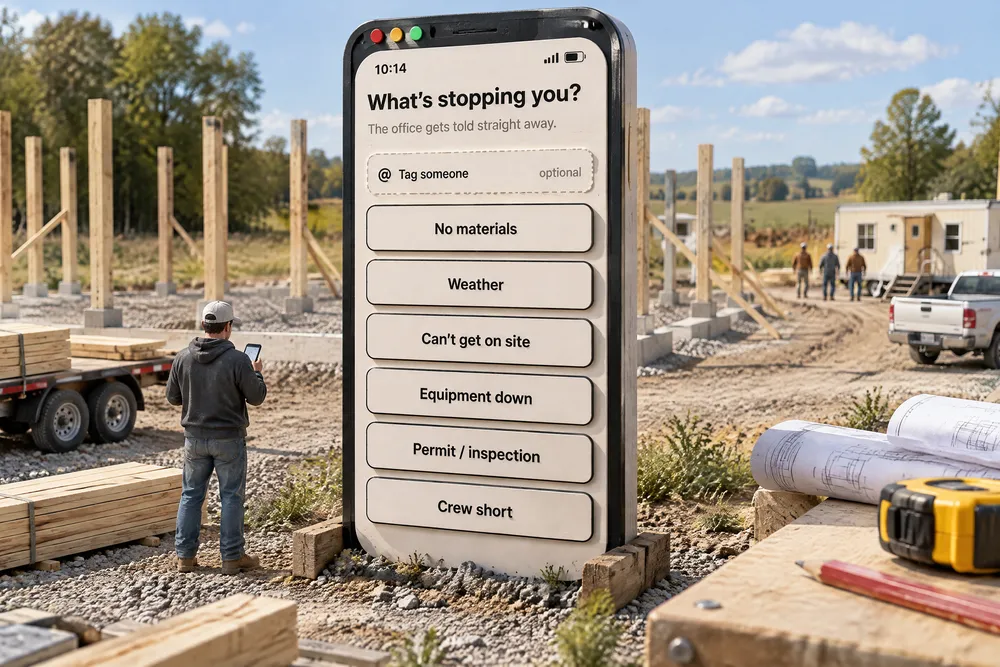
A post frame jobsite delay alert should take the crew one tap and a reason (no materials, weather, can't get on site, equipment down, permit, crew short, scope question) and reach the office that minute. Ours flags the stage delayed with the reason attached, counts weather days by kind, and leaves your promised dates where they were, so the slip stays visible.
- People hold back bad news. Psychologists call it the MUM effect, and a 2018 review traces it through workplace research: we'd rather stay quiet than deliver something unwelcome. A fixed list of reason chips makes the bad news a tap instead of a phone call. Scarff et al., 2018 ↗
- Delays are normal; silence about them is what customers punish. In a vendor-run 2025 survey, construction pros named weather (43%) and material shortages (35%) as top delay causes, yet 63% of the public blamed delays on mismanagement. Mobilization Funding (vendor survey), 2025 ↗
- Customers want to hear about changes when they happen. In a vendor-run Houzz survey of 6,087 homeowners, better information on schedule changes was the top thing they wished their pros would improve. Houzz (vendor survey), 2022 ↗
- Plans stay optimistic until past delays are counted. Buehler, Griffin and Ross found people ignore their own history when predicting finish times, and the bias went away when they tied predictions to past experience. Weather days logged by kind give you that history for the next schedule. Buehler, Griffin & Ross, 1994 ↗
A Blocked button on the crew screen opens a fixed list of reasons: no materials, weather, can't get on site, equipment down, permit or inspection, crew short, scope question, something else. Weather asks one more question — which kind, from rain to smoke — so the days lost to each can be counted. Reporting notifies everyone you have designated and flags the stage delayed with that reason attached. The plan's dates stay exactly where they were.
Also called: crew can't work · waiting on materials · report a delay from site · crew stuck
Four men waiting on a delivery is money burning right now
Try itOne button on the crew screen, then eight chips: no materials, weather, can't get on site, equipment down, permit or inspection, crew short, scope question, something else. Tapping one notifies everyone you have designated, in that minute. Every hour between the crew stopping and you hearing about it is an hour you have already paid for.
A blocked crew usually tells somebody at the end of the day, by which point you have paid four men to stand and wait. The office finds out when the hours land, not while it could still send the missing bundle.
A crew that can say it's stuck in one tap says it while the day can still be saved — the bundle sent, the crew moved, the customer told. Nobody on site has to make an awkward phone call to admit they're standing still.
Chips rather than a text box, so the reasons can be counted
Try itTyping on a site in gloves and glare is close to impossible, and a typed reason cannot be counted, filtered or learned from. A fixed list makes the same delay look the same every time it happens — and weather asks which kind, so we always lose days to the wind becomes a count of wind days rather than a feeling. The thirteen kinds are the same list the office uses when it logs a weather day on the schedule or marks which weather stops a stage, so a rain stoppage from the field and a rain day logged in the office are the same word.
Delays typed as free text — 'waiting', 'no mat', 'truck late again' — that nobody can add up, so the same cause costs you days every month without ever showing up as a pattern.
A man in gloves can hit a chip; he can't type a paragraph. For you, a fixed list is what turns a month of stoppages into a ranked answer instead of a pile of excuses.
It marks the stage delayed. It never moves your dates.
Reporting blocked flags the stage delayed with the reason attached and starts the clock on it, so the cost accrues visibly instead of being reconstructed on Friday. What it does not do is shift the plan. A framer tapping a chip at 7am must not quietly re-promise the customer a completion date — rescheduling stays your decision, made off the record this creates.
The promise to the customer is yours to change, not a side effect of a tap on site. The crew reports, the stage carries the reason and the running clock, and you decide what moves — with the record in front of you.
The chips add up into where your days actually go
Overrun days are grouped by reason and ranked by total days lost, with the crews each reason hit and how often it happened. Stages that ran over with no reason recorded show up as exactly that rather than being quietly dropped. A tap in the field becomes office analysis with nobody re-entering anything.
Every month feels like it lost days to the same thing, but nobody can say which thing, how many days, or which crew it keeps landing on.
The fix for a recurring delay starts with knowing which one recurs. Because the reason was picked from a list at the moment it happened, the ranking builds itself — and the stages that ran over with no reason are named too, not hidden.
The man who reported it is told whether anyone was reached
Try itThe screen says The office has been told only when the notification actually reached somebody; if it reached nobody, it says Reported and nothing more. On a site where the alternative is ringing the office and getting voicemail, knowing the message landed is the difference between a crew using this next month and abandoning it after the first time.
A crew reports a hold-up into an app, hears nothing back, and can't tell whether anyone saw it — so next time he just phones, or doesn't bother.
A man who reports a problem wants to know it landed. An honest confirmation — told only when somebody was actually reached — is what keeps a crew using the button instead of going back to voicemail.
- 1He taps Blocked and picks one of eight chips — weather adds a second tap for which kind.
- 2The job comes off his open shift; if he isn't clocked in and runs more than one job, he picks it first.
- 3Everyone you have designated is notified in that minute.
- 4The stage is marked delayed, with the reason attached and the clock running on it.
- 5The screen says The office has been told only when somebody actually was — otherwise just Reported.
- 6Before picking the reason he can Tag someone: each person tagged gets it on their task list, or at the top of their own crew link.
Four men standing on a site waiting for a delivery cost money by the hour, and every hour before the office hears about it is spent. One tap reports blocked: everyone who needs to know is told, the stage is flagged with the reason, and the clock on the delay starts. What it never does is move the promised dates — a framer tapping a chip at 7am must not quietly re-promise the customer a completion date. And the reason is chosen from a list rather than typed, because typing on a site in gloves and glare is close to impossible, and a typed reason cannot be counted.
- Hours of paid standing time before the office hears about a blocker.
- Delay reasons that were never captured in a countable form.
- Field reports silently re-promising customer dates.