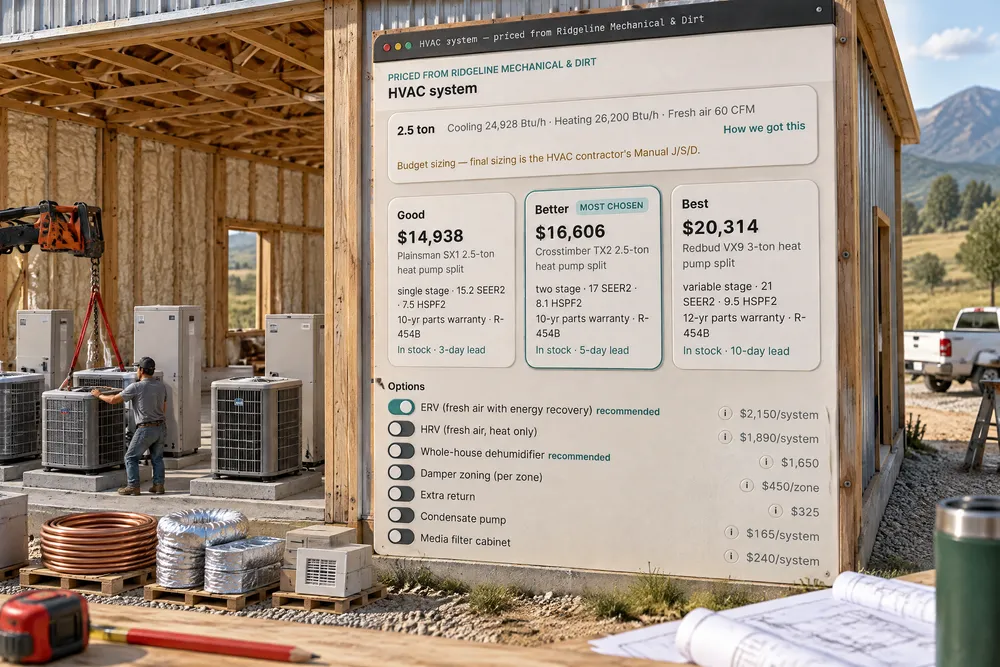
How do I get a barndominium HVAC quote onto the estimate early?
Size it from the house, not by square feet per ton, then price it from your supplier's catalog. Our barndominium HVAC quote works out a budget block load from square feet, ceiling height, insulation, glass and zones, matches Good, Better and Best systems with lead times, prices the options and adds your markup. It is budget sizing; the HVAC contractor's Manual J/S/D is final.
- Sizing has a standard, and codes ask for it. ACCA describes Manual J as the ANSI-recognized standard for residential equipment sizing loads and says a load calculation done to it is required by national building codes and most state and local jurisdictions. That is why an early budget load is labeled budget and the contractor's calculation stays final. ACCA ↗
- The first number the customer reads becomes the yardstick. Tversky and Kahneman showed people adjust too little from a starting figure, so an HVAC guess that moves after the estimate has been read gets judged against the guess, not the house. Tversky & Kahneman, 1974 ↗
- Trade numbers are what hold a full price up. Rural Builder reports a turnkey barndo bid takes about a week to ten days, held up by sub quotes and site facts, while a shell can be bid in minutes. Rural Builder, 2024 ↗
- Barndos are houses in the code's eyes. NFBA's Frame Builder magazine notes a post-frame barndo's structure falls under IBC requirements and advises checking with the building department early to avoid costly delays. NFBA, 2025 ↗
An HVAC configurator on the estimate and on the barndominium project. You describe the house — square feet, ceiling height, insulation, glass, storeys, bedrooms, fuel and zones — and it works out a budget block load (walls, roof, glass, air leakage, fresh air and people), never square feet per ton. From your supplier's catalog it matches Good, Better and Best systems at that size, with efficiency, warranty, stock and lead time, then prices the options (fresh air, dehumidifier, zoning, thermostat, line set, ductwork, permit, startup) and adds your markup. Every result says what it is: budget sizing — the HVAC contractor's Manual J/S/D is final. Built for barndominium builders with an in-house HVAC division or a regular HVAC supplier, in the operating system built exclusively for post-frame and barndominium builders.
Also called: hvac configurator · heat pump quote · hvac on the estimate · mini split pricing · good better best hvac · hvac sizing · barndominium hvac
Good, Better and Best from your supplier's own catalog
Try itDescribe the house once and three priced columns appear at the same size: a single-stage system, a two-stage one and a variable-speed one, each with its efficiency, warranty, stock and lead time. They come from the catalog your HVAC supplier or in-house division keeps in supplier-maintained trade catalogs, matched on capacity, refrigerant and the supplier's own rules. Switch options on and off — fresh air, a dehumidifier, zoning, the thermostat — and the price breakdown shows the supplier's price beside yours on every line.
The customer asked what a better system would cost and the answer was "I'll find out".
The upgrade conversation is one click while the customer is still at the table, and you can see your margin on every line before you say a number.
A budget load that shows its working
Try itThe size comes from a simplified block load — walls, roof, glass, doors, slab edge, air leakage, fresh air, people and humidity — worked out from the house you are quoting, never from square feet per ton. A closed-cell spray-foam shell sizes smaller than the same house in batts, because it is tighter and better insulated. How we got this prints every number with the assumption behind it, and every result carries the same label: budget sizing — the HVAC contractor's Manual J/S/D is final.
A tight foam barndominium got a system sized off a square-feet-per-ton rule, and it short-cycled.
Nobody has to trust a black box, and nobody mistakes a budget number for the contractor's design.
On the estimate at the supplier's price, with your markup
Try itAdd to estimate puts the quote in as its own group of lines — equipment, ducts, fresh air, labor, permit and startup — at the supplier's price, frozen the moment they are added, with your markup as each line's markup. Your markup rules treat them like every other line, and sales tax is added after markup, never marked up. Remove takes the group off and the estimate total goes back to the cent.
The HVAC allowance on the estimate was a guess, and the real number arrived after the customer had signed.
HVAC stops being one round allowance nobody can explain, and a sent estimate never moves when the supplier changes a price.
Fresh air on a foam house is checked, not remembered
On a spray-foam house the fresh-air unit (an ERV) starts switched on, because a shell that tight needs mechanical ventilation. Take it off and a Check appears on the quote. Add damper zoning to a single-stage system and a Fix appears, because damper zoning needs a two-stage or variable system. The checks come from the supplier's own rules plus one that can't be switched off: the outdoor unit and indoor coil must use the same refrigerant.
Fresh air was left off a spray-foam house and nobody noticed until the windows sweated.
The mistakes that cost a callback are caught while the quote is being written, by rules the supplier keeps.
Accepting sets the project's HVAC package
On a barndominium project, Accept → HVAC package sets the job's HVAC trade package at the supplier's price — your own division's agreed price when the division supplies it (see barndominium trades and internal division commitments). It also starts the owner's House Book with the outdoor unit, the air handler and the fresh-air unit, ready for serial numbers at startup. A package already accepted keeps its price; a new figure waits for a change order.
The HVAC price agreed on the estimate and the one in the job budget drifted apart.
The number the customer saw becomes the number the job is budgeted at, and the owner's equipment record starts itself.
- 1On an estimate, HVAC system → Configure HVAC; on a barndominium project, open the HVAC package and configure it there.
- 2Fill in the house. A tight spray-foam shell sizes smaller than a leaky one the same size, because the load is worked out, not looked up.
- 3Pick Good, Better or Best — three priced columns from your supplier's catalog, matched on capacity, refrigerant and the supplier's own rules.
- 4Switch options on or off; on a spray-foam house fresh air (an ERV) starts switched on, and a check appears if you take it off.
- 5Add to estimate puts the lines in at the supplier's price, frozen, with your markup as each line's markup — sales tax is never marked up.
- 6Accept → HVAC package sets the project's HVAC trade package at the supplier's price and starts the House Book with the equipment.
- 7How we got this shows every number in the load and the assumption behind it.
Barndominium builders install HVAC on nearly every house, and the number usually arrives late — a phone call to the HVAC company, a guess in the meantime, and an estimate that moves after the customer has read it. Builders with their own HVAC division asked for the division's prices to flow straight into the builder's estimates, kept up to date by the people who buy the equipment. Sizing by square feet per ton oversizes tight spray-foam houses, so the module works out a budget load instead and labels it honestly.
- An HVAC line priced from memory while the estimate is being written
- Waiting on a separate company or division for a number the customer wants now
- Oversized systems from square-feet-per-ton rules on tight foam houses
- No easy way to show the customer a better system and what it costs
- Supplier price changes silently moving an estimate already sent