How do post frame builders get their construction SOPs followed?
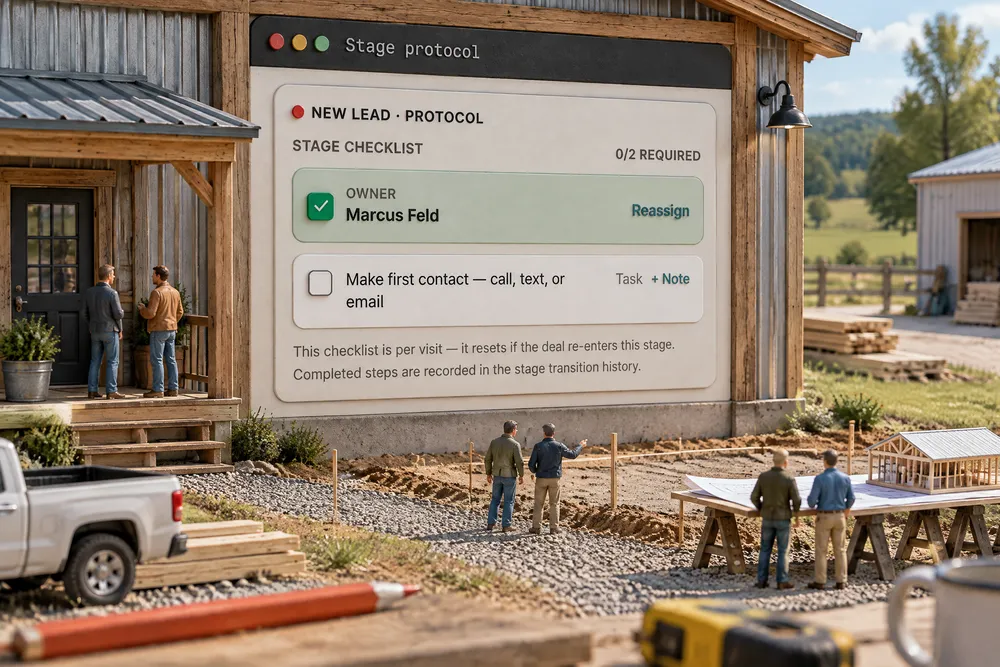
Put each SOP on the stage it belongs to, not in a binder. Post frame construction SOPs get followed when every pipeline stage carries its own ordered steps, marked required or optional, with a note on each and a task that ticks the step when it's done. The list resets when the deal moves on, so a new hire sees what this stage needs today.
- Checklists work because skilled people skip steps under pressure, not because they don't know them. When eight hospitals adopted a 19-item surgical checklist, deaths fell from 1.5% to 0.8% and complications from 11.0% to 7.0%. Haynes et al., 2009 ↗
- Good intentions fail at the moment of action. Plans written as "when this happens, I do that" hand the trigger to the situation and raise follow-through well beyond intention alone, which is why a step that becomes a dated task gets done. Gollwitzer, 1999 ↗
- A process that lives in one person's head has to be relearned by every new hire, and new hires come and go: across the industry, 83% of contractors lost some new field hires inside their first 90 days. AGC & NCCER, 2026 ↗
- Small contracting firms tend to depend on the founder for nearly everything, Harvard's Joint Center found. Writing the steps where the work happens is how the process stops depending on who is handling the deal. Harvard JCHS, 2014 ↗
The process sits on the stage, not in a training document nobody reopens. Steps are marked required or optional, carry a hint, and each one holds a note — "left a voicemail, try after 5". Ready to advance means every required step is done. The list resets when the deal moves on. Change a step in Settings and every screen that reads it follows — the card checklist, the Leads Manager's follow-up counts, bulk triage, imported leads and the lead's timeline.
Also called: SOP · standard operating procedure · what to do at this stage · sales checklist · process
The process sits on the stage, not in a training document nobody reopens
Each stage carries an ordered list of steps, marked required or optional, and each step holds a note — "left a voicemail, try after 5". What actually happened on a deal used to depend on who was handling it and how busy he was that week. Now the steps travel with the deal, and "did anyone call them back" has an answer rather than an argument.
Two reps work the same kind of lead two different ways, one never calls back, and the deal goes to whoever did.
A new rep knows exactly what to do next on any deal without asking, because the steps are on the deal itself. The owner gets the same process from every rep, which is how follow-ups stop depending on who caught the lead.
"Ready to advance" is a worked-out answer, not somebody's opinion
Try itRequired and optional steps are counted separately, so a stage is ready when every required step is done and the nice-to-haves stop being a blocker. The steps ramp from deep red to green by position, so a checklist visibly greens up as it is worked and a stalled deal reads red from across the room.
Deals get moved on because they feel ready, with the decision follow-up never made, and they die quietly in the next stage.
The rep knows when a deal is genuinely ready to move, and the manager stops arguing about it. Optional steps stop blocking good deals, and red rows show a stalled one from across the room.
A step's task and the step tick together
Try itPress Task on a step and it becomes a task — Call Jo back about the estimate, due Thursday — that remembers which step it came from. It shows up wherever the rep works: on Home, on the customer's page and in Contacts › Tasks, all reading the one list for that person. Finish the task anywhere and the step on the deal ticks itself; tick the step on the card and the task closes. Untick either and the other reopens. It only ticks a step that belongs to the stage the deal is in now, so a task from last stage can't tick this stage's list.
The rep ticked off the callback on Home, the deal's checklist still said nobody had called, and the manager chased a lead that had already been handled.
The rep works from his task list and the manager reads the checklist on the card — now they're the same answer, so "did anyone call them back" doesn't depend on which screen you looked at.
It doesn't ask a man to do the thing he just did
Being in Estimate Sent means the estimate was sent, so that step arrives already ticked. It also cannot be removed — it is the step whose completion is the stage — and it is pinned back to the top if an edit leaves it out. A checklist that tells a rep to send the estimate he sent ninety seconds ago is a checklist he stops reading.
The checklist tells the rep to send the estimate he sent a minute ago, so he learns to tick through it without reading.
Reps keep reading a checklist that doesn't waste their time on things already done. A list that notices what just happened is a list people trust — and follow.
Write your own steps without orphaning last year's records
Defaults ship for every stage and any of them can be rewritten. Labels, hints, order and whether a step is required are all free to change, because live deals and the history hold a lasting identity rather than the words on screen. Rewording a checklist does not quietly change what the record says happened two years ago.
Renaming a step makes old deals show the new words, so the record no longer says what anyone actually did at the time.
The owner can reword the process as the business learns, without rewriting what happened on last year's deals. History that stays put is history you can rely on in a dispute.
Every rep can read the process; only an admin rewrites it
Reading the steps is open to anyone working the pipeline, because a checklist that needs a permission to see is a checklist nobody follows. Changing them is an admin action. A new man can answer his own question about what happens next without being able to quietly drop the step he finds annoying.
A busy rep deletes the follow-up step he never does, and the whole team stops doing it without anyone deciding to.
Any rep can look up what happens next without bothering anyone, and nobody can quietly drop the step he finds annoying. The process stays the owner's, not whoever edits it last.
You write the checklist, not us
The steps are yours to edit — add the one that stopped last year's lost deal, delete the one that never applied to how you sell. Labels, order and required or optional are all yours, saved per stage.
Vendor-written steps describe a company that isn't yours, so the team learns to tick through them without reading — which is worse than having none.
Reps follow a checklist the owner wrote after a deal went wrong, because everyone remembers why each step is there. A process you own is one the team actually uses.
Your own follow-up steps still count as follow-ups
Try itReplace Follow-up 1, 2 and 3 with your own Second Contact Attempt and Third Contact Attempt, and each Contacted step carries a tag you click: contact attempt or not an attempt. Steps marked contact attempt are what "followed up once / twice" counts in the Leads Manager and on imported leads — the first one is first contact, each one after it is a follow-up. A step like Future Buyer stays not an attempt, so it never inflates the count.
You rename the follow-up steps and the Leads Manager quietly counts boxes nobody can see any more, so every lead reads as never followed up.
The sales manager's "followed up twice" filter means what it says, even after you rename every step. Honest counts mean the leads that really need a third call get one.
Change the SOP once and every screen follows
Save a stage in Settings → Pipeline SOPs and it is live on the board the moment you save — the checklist on every card, the Leads Manager's follow-up counts, bulk triage and imported leads all tick and count your steps, not the built-in ones. A screen already open picks up the change without a reload. And a custom step you later delete still reads as words in the lead's timeline, never as a code.
You update the checklist, the card shows the new steps, but the import and the follow-up filter still tick the old ones — and the numbers stop matching the cards.
The office never works off an old version of the process on one screen and the new one on another. One process everywhere means a change the owner makes on Monday is how the whole team works on Monday.
Every follow-up step you write asks why the lead is waiting
Set a reminder from any Contacted step after first contact — the built-in follow-ups, nurture, or your own, like Future Buyer — and it asks why the lead is waiting. It reads your saved checklist, so a step you added yourself asks too.
A lead parked under a custom step never gets a waiting reason, so three weeks later nobody knows if it was a "call in spring" or a dead lead.
The rep records why a lead is parked at the moment he parks it, so the next person to pick it up knows whether to call or wait. No lead sits forgotten just because its step had a custom name.
- 1Open a deal and see the steps for the stage it's in.
- 2Work down the list, leaving a note on any step.
- 3Press Task on a step to turn it into a task with a due date — finish the task anywhere and the step ticks itself; tick the step and the task closes.
- 4Required and optional are counted separately.
- 5The step that is the stage arrives already ticked.
- 6Rewrite the steps for your company — an admin action.
- 7Mark which Contacted steps are contact attempts — that is what "followed up twice" counts.
- 8Moving the deal on resets the list for the new stage.
The steps a deal is supposed to go through lived in a training document nobody reopened, so what actually happened on a deal depended on who was handling it and how busy they were. The checklists sit on the stage now. Steps that are already true by virtue of being in the stage — being in Estimate Sent means the estimate was sent — tick themselves on arrival, because telling a rep to do the thing whose completion is the stage reads as software that did not notice what just happened.
- Process living in one person's head
- Checklists that ask for work the system already knows happened
- Edits to a checklist orphaning historical records
The checklist is kept when a deal leaves a stage
Nothing is lost when a deal moves on. The checklist as it stood, and which steps were on offer at the time, are copied onto the history first. Then the live list clears for the new stage. It works the same whether the deal was moved by hand or moved itself.