The short answer: A pole barn sales pipeline is the set of stages a lead moves through to a signed contract (new lead, contacted, site visit, estimate sent, follow-up, signed), with a rule for what has to happen at each one. It tracks where every job stands, whose move it is and how long it has sat there, which a notes app or a stack of estimate sheets on the passenger seat can't show.
Most builders already have a sales pipeline. It is the notes app on the owner's phone, the stack of quote sheets on the passenger seat, and the three names he keeps meaning to call back. It works right up until the month it doesn't, and the month it doesn't is usually the busy one.
A construction sales pipeline is not a list of names. It is the set of stages a lead moves through on the way to a signed contract, with the rule for what has to happen at each one. The names are the least important part. What the pipeline actually tracks is where every job stands, whose move it is, and how long it has been sitting there.
A pipeline is stages, not contacts
A contact record answers "who is this?" A pipeline answers "what happens next?" Those are different questions, and most generic tools only answer the first one well.
For a post-frame builder the stages are close to universal, even if nobody has written them down: a lead comes in, someone qualifies it, a site or a plan gets looked at, an estimate goes out, the customer approves, the contract is signed. Each stage has an exit condition. You cannot move a lead to "estimate sent" until the estimate has been sent. You cannot move it to "approved" on a hopeful phone call.
That is the whole idea. The pipeline is a board of stages, and a lead sits in exactly one of them. Stack the board up and you can see at a glance how many jobs are waiting on you, how many are waiting on the customer, and how many have quietly gone cold.
What the pipeline tracks that a contact list cannot
Three things, and they are the three that decide whether a lead becomes a building.
Whose move it is. A lead at "estimate sent" is waiting on the customer. A lead at "new" is waiting on you. A board that shows the split tells the office where to spend the next hour, instead of leaving it to whoever's name is loudest in memory.
How long it has been sitting. Every stage has a normal dwell time. A quote that has sat unanswered for nine days is not a quote anymore; it is a follow-up that nobody made. When the board carries the age of each card, the nine-day quote turns a different colour before it turns into a lost job.
How good the lead was in the first place. Not every enquiry deserves the same afternoon. A grade on the lead, set by the rep and visible on the board, lets a two-person office spend its estimating hours on the shop that has a budget and a site, not the one that "might do something next year."
Why "we'll remember" stops working
The answer is arithmetic. A builder who takes twelve enquiries a month has, at any moment, thirty or forty leads somewhere between first call and signed contract. Each of them needs a next action on a date. Nobody remembers forty next actions, and a spreadsheet that has to be opened and read is a spreadsheet that gets opened on Friday, after the week's damage is done.
Harvard Business Review reported research by Jason Jordan and Robert Kelly that found companies with a formally defined sales process grew revenue faster than those without one, and that the gap widened for the companies that actually spent time managing the pipeline rather than only owning one. The mechanism is not mysterious. A defined stage with a defined exit means the follow-up is a rule, not a memory.
For a post-frame shop that translates directly. The buildings are big-ticket and slow to decide. A customer who gets a quote in March and hears nothing until he calls in May has been given two months to talk to someone else.
An automated pipeline versus a manual one
A manual pipeline is a board somebody keeps up. The rep drags every card, remembers every next step, and the board is only as current as the last person who touched it.
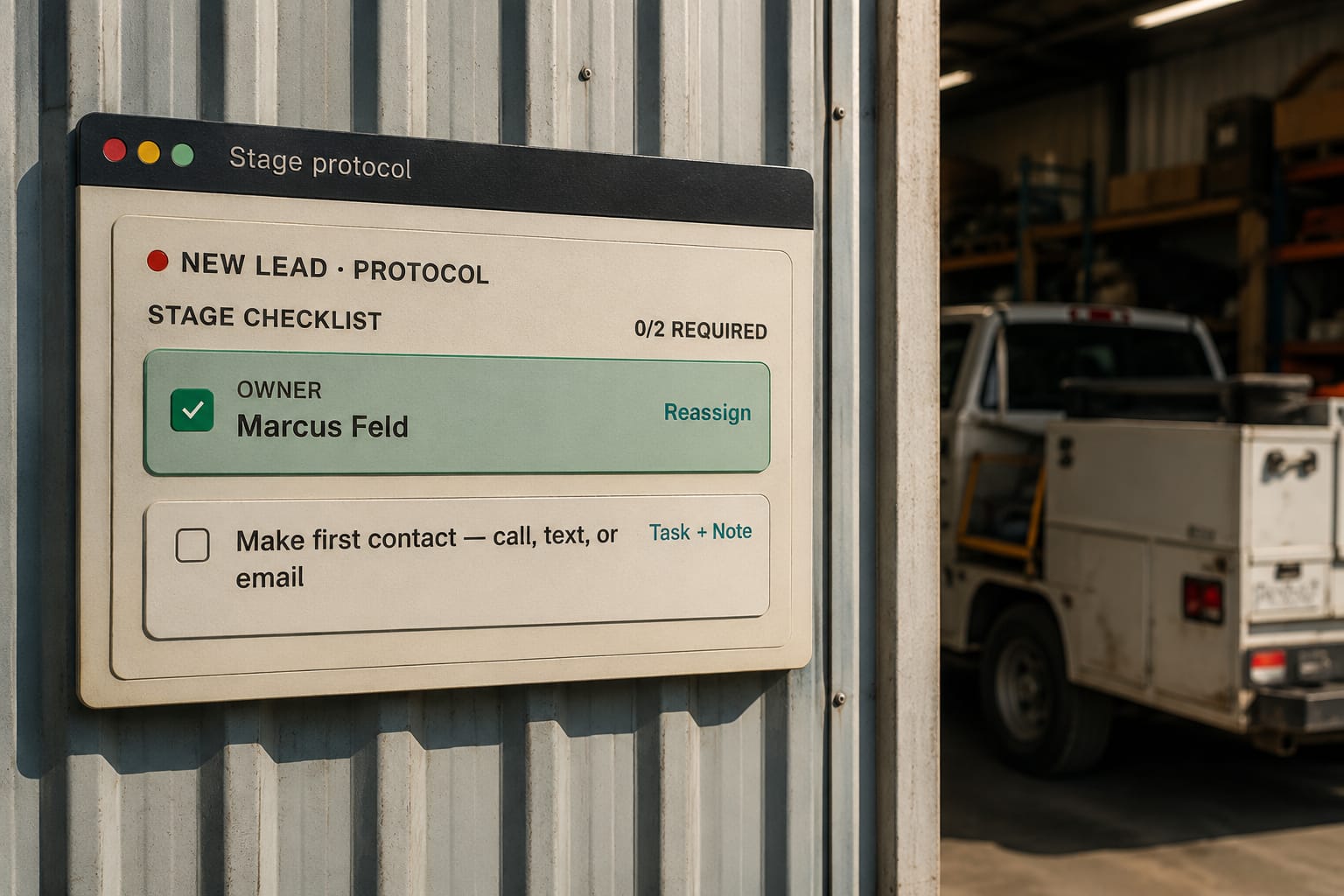
An automated pipeline moves on what actually happened. In Leads 2 Build, an estimate sent, an approval, the customer's intake form, a contract sent and a signature each move the card forward on their own, never back. A deal that sits too long in a stage gets flagged and its rep nudged. Every stage comes with its checklist already written, and each stage's steps carry their own tasks and notes: finish the task and the step ticks itself. The builder edits the steps to fit how he sells; he doesn't build the automations.
What "built around how builders sell" means
Software written for a SaaS sales team assumes a rep works a queue of small deals by phone all day. A builder sells a $90,000 shop to a man who wants to see it, change the doors, sleep on it, and have his wife look at the price. The pipeline has to fit that shape or it will be abandoned by week three.
Fitting it means a few concrete things. The lead card needs the building on it, not only the phone number, because the next conversation is about the building. The estimate needs to be reachable from the card, because the customer's next question is about the estimate. And the message thread with that customer needs to live in the same place, because the follow-up is a text, not a CRM task.
On every card, a post-frame or barndominium pipeline should carry:
- The building. A pole barn or barndo tag, plus what he wrote on your form: size, use, timing and budget, when the form asks.
- The permit question. His address looked up to the city and county, and whether a permit is required there, before a price goes out. Our permit check answers it wherever we hold the rules, 5,273 towns and cities across 640 counties in 13 states so far.
- The grade the rep gave him.
- The work. Notes, tasks with due dates, and every text, email and call in one thread.
- The follow-up. Which email and text sequences he is in, and why one stopped.
A generic CRM hands you Lead, Opportunity, Won and a blank checklist, and leaves the rest to you. Leads 2 Build works exclusively with post-frame and barndominium builders, so the stages are named after what happens on a building sale and end where the build begins. A barndominium sold in two steps can carry a paid planning deposit before the final contract.
Every item above is on the sales pipeline we built for post-frame and barndo builders, and how the board works, stage by stage, is that page's job, not this one's.
The number a pipeline gives you that nothing else does
Once leads move through named stages, the board starts producing one figure the owner never had before: the value of the work sitting at each stage right now. Twelve leads at "estimate sent" worth $640,000 is a fact about next quarter. Four of those older than ten days is a fact about this afternoon.
That figure is what turns follow-up from a chore into a decision. It is also the reason the pipeline belongs inside contractor management software rather than beside it: the estimate that sets the value and the contract that closes the stage are the same records the pipeline is moving.
For a post-frame shop that pipeline lives in a construction CRM built around the building you sell: leads can route to the rep who covers the county, and each card shows how long the lead has waited.
What the research says
- When everyone could act, each person feels less need to. In Darley and Latané's experiment, people who believed others also heard an emergency felt less personal responsibility and responded more slowly than people who thought they were alone. A lead that everyone in the office can see but nobody owns gets the same treatment; a pipeline stage with a named owner removes the doubt about whose move it is.
- How leads get handed out decides how fast they get answered. HBR's study of online sales leads named pulling leads from the CRM once a day, and distribution rules based on geography, as main causes of slow response. A pipeline that shows each new lead the moment it lands, with a clock on how long it has waited, fixes the handoff rather than the people.
- A pipeline you can see is one you act on. A meta-analysis of 138 studies by Harkin and colleagues found that monitoring progress raised goal attainment, more so when the information was physically recorded or public. Stages on a board, with days-in-stage counting up, are the recorded version of "I keep meaning to call him back."
- Not every lead deserves an estimate yet. Rural Builder's "Post-Frame Bidding Blues" reports post-frame builders dread bidding wish-list customers who walk when they see the numbers, and recommends pre-qualifying before putting bid time in. A qualifying stage before "estimate sent" puts that rule into the pipeline itself.
Where this fits, and where it doesn't
A pipeline is the front third of the job. It ends the day the contract is counter-signed and the project begins. If most of your pain is after that point, in scheduling, crews and change orders, the pipeline is not your first fix, and the list of contractor management tools, sorted by who each fits is the better place to start.
And a pipeline cannot invent leads. It can only stop losing the ones you have. If the board is empty, the problem is upstream, and where post-frame leads actually come from is the read for that week.
But if you have ever found a quote sheet in the truck from a customer you meant to call, the pipeline is the fix, and the fix is a set of stages with a rule for each one. The names were never the problem. Knowing whose move it was, was.