The short answer: Post frame construction cost is set by more than square footage: wall height, roof pitch and snow load, doors and openings, site work, the slab, when steel is bought and the labor to put it up. A calculator gives a usable ballpark only for a plain shell. Give buyers a range tied to those seven choices, then a real price once you have measured the site.
Type "pole barn cost calculator" into Google and you'll get a dozen tools that will happily give a stranger a number for a building nobody has looked at. They're useful — they set a ballpark, they qualify a buyer, and they're a perfectly good reason for someone to pick up the phone.
What they can't do is be right. Here's what actually drives post-frame construction cost, why calculators land well off in either direction, and how to give a customer a figure you can stand behind before you've done a full takeoff.
What a calculator actually knows
Almost every online calculator asks three things: width, length, and height. Some ask about doors. Then they multiply by a price per square foot pulled from a national average.
Square footage is a reasonable proxy for exactly one thing: the roof and wall area of a simple rectangular box on flat, dry, accessible ground, built to a generic spec, in an average market, this time last year.
Change any of those and the number moves — sometimes by more than the profit on the job.
The seven things that move the number more than square footage
1. Wall height. Going 14 feet instead of 12 doesn't add 17% to the walls. It adds posts of a different length, more girts, more wall steel, and sometimes a different truss bearing detail. Height is the most underestimated variable in post-frame.
2. Roof pitch. A 4/12 and an 8/12 on the same footprint are different buildings — more roof area, different truss, more labour, sometimes different equipment.
3. Openings. Every overhead door is a header, jamb, trim, and a hole in the wall where steel would otherwise be. Two 10×10s and one 16×14 have different costs and different structural consequences.
4. Site. Slope, fill, access, and whether a concrete truck can reach it. This is the single biggest variance between a calculator's number and a real quote, and no calculator asks.
5. Concrete. Slab or no slab, thickness, mesh or fibre, thickened edges. A slab can be a quarter of the whole job.
6. Steel price at the moment of ordering. Not the moment of quoting. Panels have moved double digits in a season more than once.
7. Your market's labour. A national average is an average of markets you don't build in.
Why the number is usually off in a specific direction
Calculators tend to run low for a working builder, for a reason that isn't cynical: they price the building, and a builder sells a finished job. Site prep, permits, engineering where required, delivery, equipment days, cleanup and overhead often live outside the calculator's model entirely.
Which creates the problem builders actually live with: the customer arrives anchored to a number that never included half of what they're buying, and your accurate quote looks like an upsell.
How to answer "roughly what would it cost?" without lying
You'll get asked on the phone, before you've measured anything. Refusing to answer costs you the lead; guessing costs you the margin. A structure that does neither:
- Give a range, not a number. "For a 40×60 with 14-foot walls, most of what we build lands between $X and $Y."
- Name what moves it. "Where you land in that range depends mostly on the slab, the site, and how many doors."
- Name what's not in it. "That's the building and the slab — it doesn't include site fill or electrical."
- Give a date for the real number. "I can have an exact figure to you Thursday."
That conversation takes ninety seconds, sets a defensible expectation, and — this is the part builders miss — makes your eventual quote look more trustworthy than a competitor's single confident number.
What actually produces a number you can stand behind
The reliable way is unglamorous: derive the materials from the building's real geometry, price them at today's supplier costs, add your real labour by stage, and add overhead and margin as stated rates rather than as a feeling.
That's what separates the three kinds of estimating tool, and it's worth understanding before you buy one — we compared all three camps with real pricing. For pole-barn-specific tools, the honest fit guide runs the same evaluation.
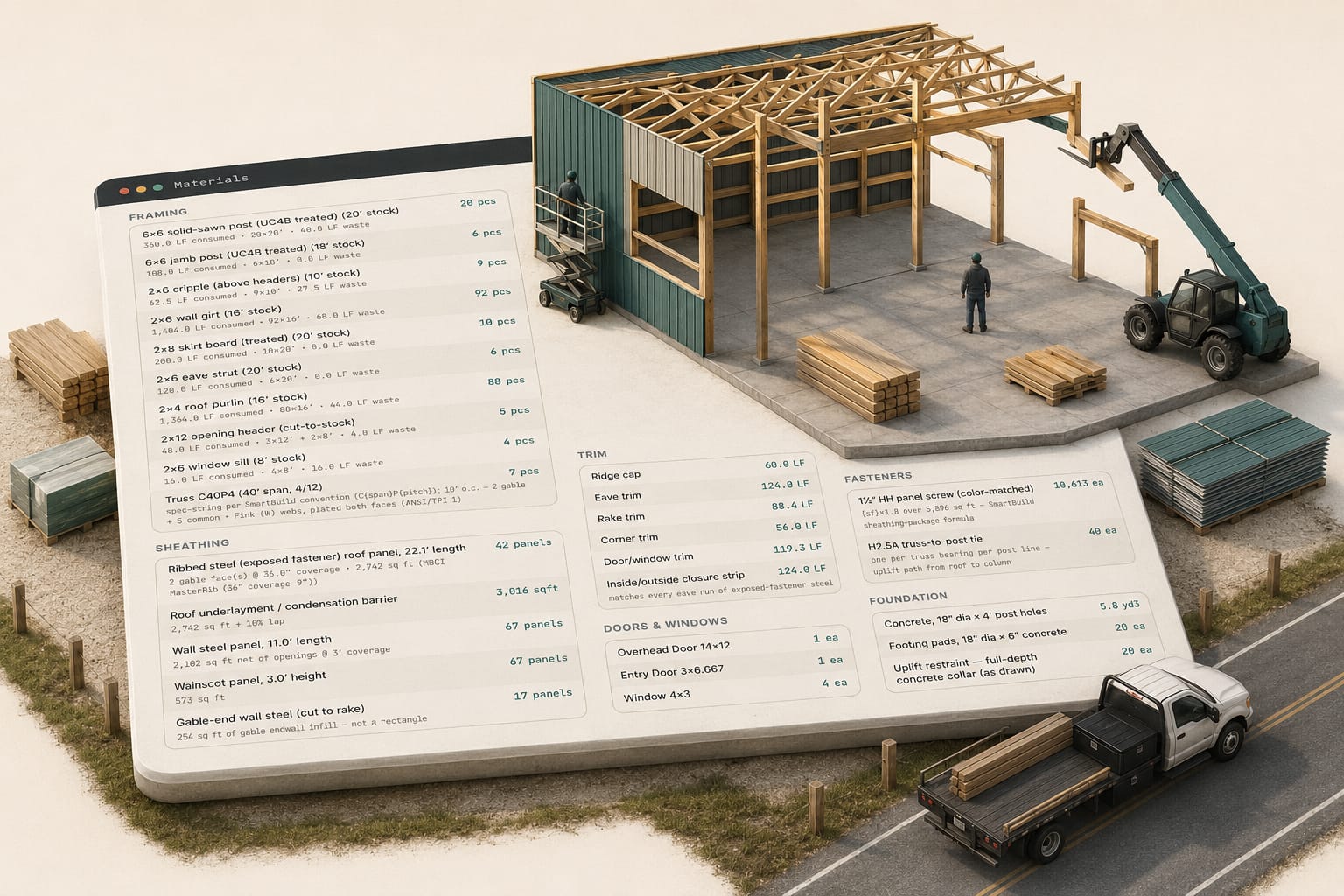
For what it's worth, ours derives the list from a 3D model of the building, so moving a door or stretching the span re-prices in front of the customer instead of sending you back to a spreadsheet. Here's the flow.
Which is to say: geometry and your own prices, not averages. Draw the building and the takeoff follows from it, priced against your yard's material costs rather than a national figure that was never yours.
Should you put a calculator on your own site?
Yes — with two conditions.
Give a range, and say what it excludes. A calculator that produces a single confident number is manufacturing the exact anchoring problem you'll have to argue with later.
Capture the lead, and follow up fast. A calculator is a conversation starter that identifies people actively planning a building. Its value is almost entirely in what happens in the next hour.
When that lead does call, the number that holds comes from construction estimating software that counts the building while you draw it: the list comes off the geometry, so a moved door re-prices from the building rather than from a rate.
What the research says
- The first number a buyer hears becomes the yardstick. Tversky and Kahneman showed that when people estimate a number they start from an anchor and adjust too little, which produces errors in a predictable direction. A calculator figure for a bare shell becomes the anchor, so the full price later feels like a jump even when nothing was padded.
- Shell and turnkey are different buildings at different prices. One Kentucky and Tennessee builder's 2025 cost guide puts a shell at about $50 to $100 per sq ft and turnkey at about $150 to $300, prices porches and shops separately, and says site prep and utilities often surprise homeowners. One builder's figures, but the spread shows why a single per-foot number misleads.
- Much of the real job sits outside the building price. A Michigan builder's 2026 pole barn cost guide says its price excludes permits, significant site prep and, unless ordered, concrete, and holds prices for 30 days because steel follows commodity markets. A calculator that leaves those out is not wrong, it is answering a smaller question.
- Two prices for "the same size building" often aren't the same building. In one case a kit supplier wrote up, competing prices differed on sidewall height, roof style, siding and wind exposure, and once the specs matched, the price fell from about $33,000 to about $21,000. Comparing on square feet alone hides exactly the choices that move the number.
- Material prices move most for small builders. In NAHB's 2026 survey, builders with five or fewer starts saw material costs rise 9.1% in a year versus 1.8% for the largest builders. A calculator built on last year's steel price is off before anyone touches it.
The number that matters
The one your customer remembers is the one you said first. Make it a range, make it honest about what's excluded, and make the real quote arrive when you said it would.
If you want the engineering references behind post-frame spans, snow and wind loading — the things that genuinely change a building's cost — the National Frame Building Association is the trade's own source.
One open loop: a number the customer accepts is only half the job. What it costs you depends on what happens after the contract — the changes, the weather days, the draws — and none of that is in any calculator.