How should pole barn change order billing work?
Pole barn change order billing should match how you agreed the extra on site: bill it on its own, give it its own payment plan, or fold it into the remaining draws. On its own is the safest, since the schedule your customer agreed to stays untouched. Our billing choices explain each option in plain words and lock once the invoices exist, so nothing bills twice.
- Every separate payment is felt on its own. Prelec and Loewenstein describe an immediate pain of paying, which eases when payment is decoupled from each purchase. A surprise bill for an overhead door, after a deposit and a draw, re-opens that pain, which is why customers say they felt billed twice. Prelec & Loewenstein, 1998 ↗
- On a financed barndo, the bank decides what can be folded in. Unbudgeted change orders found at a draw inspection are a known reason a draw is held. Ledger Trade & Capital ↗
- An extra the customer can't see in writing is an extra they can dispute. A post-frame supplier's contract rule is blunt: if it is not in writing, it does not exist, and anything outside the written contract needs its own change order. Hansen Pole Buildings, 2026 ↗
Three choices per change order. On its own is the safest and the most common — the agreed schedule is left untouched. Its own plan gives the extra a titled schedule of its own. Folded in spreads it across the remaining draws, which changes amounts your customer has already seen — and the screen says so, in those words. Post-frame extras are the usual ones — an overhead door, a lean-to, a wainscot change — and each can be billed the way you talked about it on site. The change order and its invoices sit together in the job's Billing card.
Also called: surprise second invoice · customer feels double billed · how do I bill the extra · change order billing
Three ways to bill an extra, so it does not land as a surprise second bill
Bill it on its own, give it its own payment plan, or fold it into the schedule your customer already agreed to. Each choice is explained on the screen in plain terms, including what it costs you — folding it in changes amounts your customer has already seen. A mid-build change between $5,000 and $100,000 arriving as its own invoice is what makes a customer feel double-billed.
Every extra you add mid-build goes out as its own invoice, so the customer who has already paid a deposit and a delivery draw opens a third bill and phones you convinced he is being charged twice for the same shop.
A customer who agreed to an extra on site should get a bill that matches what you said — not a surprise. These three came out of a real complaint: the money was never disputed, the shape of the bill was. Deciding it at pricing time keeps the invoice matching the conversation.
Split one change order into buckets and send each where it belongs
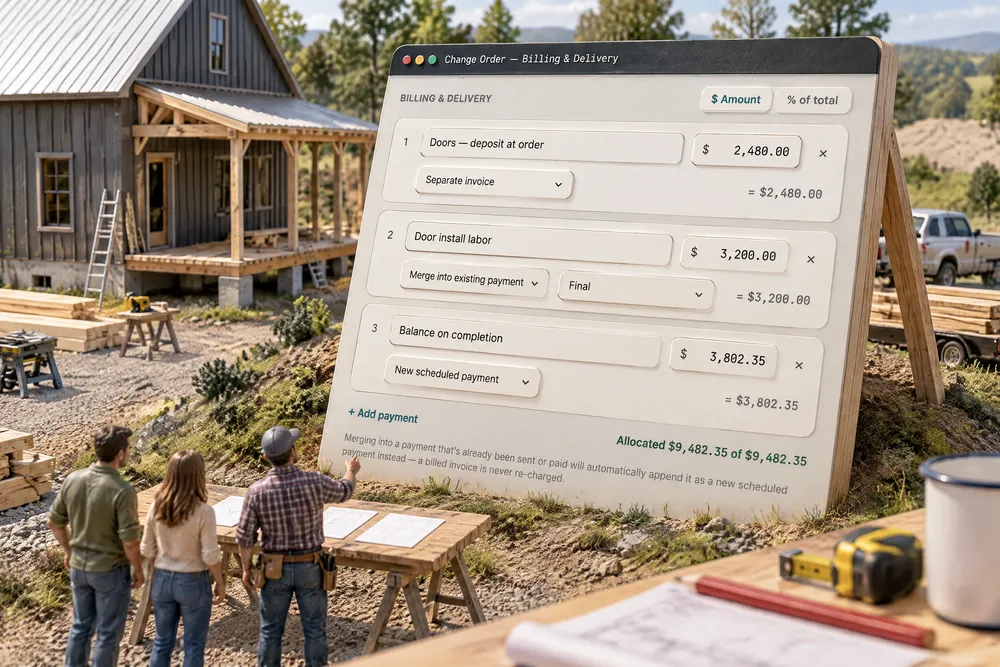
Name each bucket, give it an amount in dollars or as a percentage, and route it on its own. The materials can go out on their own invoice now, while the labour is added to the schedule and a third piece folds into the draw your customer is already expecting. The allocation line refuses to go green until the buckets add up to the change order total.
One $9,000 extra covers a door deposit the supplier wants this week and labour that is not earned until delivery, and billing it as a single lump forces you to ask for all of it months early or wait months to ask at all.
Asking for money when you've earned it feels fair to the customer; asking months early doesn't. One extra rarely has one payment moment, so the routing sits on each piece rather than on the change order as a whole.
A folded-in extra shows as its own line on the draw, not as a bigger number
When a bucket folds into a scheduled payment, it becomes its own itemised line on that invoice, and the base amount stays fully visible above it. Every folded line records which change order and which bucket produced it, so an invoice line traces back to the extra your customer agreed to.
You fold the extra into the delivery draw, the customer opens a number that is $3,240 larger than the one he signed, and your evening goes to reconstructing where the difference came from.
A customer pays a bill he can read without ringing you. A folded extra arrives carrying the change order's name, not as a number that quietly grew — and every line records which change order and bucket made it.
It will not touch an invoice your customer already has, and it will not bill twice
A fold-in is only allowed into a draft. A draw that has already gone out falls back to a new scheduled payment; one that has vanished falls back to its own invoice. Buckets already billed or already paid are skipped and reported as they are, so running it a second time produces no second set of invoices — and a bucket that failed stays pending for a retry rather than being quietly dropped and underbilled.
You chose a draw to fold the extra into on Monday, someone sent that draw on Wednesday, and the plan you made is now a rewrite of a bill already sitting in the customer's inbox.
A bill the customer has already opened must never change under him. Each unsafe route steps down to the next safest instead of overwriting, and a second run finishes what a failed one left — so a hiccup mid-billing is never yours to untangle by hand.
The change order marks itself paid once every invoice it created has cleared
Try itAfter a payment is recorded, the invoices that change order produced are checked, and only when all of them are settled does it move to paid. A bucket folded into a draw shares its invoice with the base payment, so that whole invoice has to clear before it counts. The change-order list becomes a collection tracker for your extras — otherwise a cross-check you do by hand.
Three months on, one change order lives as a standalone invoice, a scheduled payment and a line buried inside the delivery draw, and the only way to know whether you were actually paid for it is to open all three.
You want to know you were paid for an extra without opening three bills to check. The rule is cautious: a part payment on a shared bill could be the base draw and none of your extra, so nothing counts until the whole bill clears — under-reporting is the safe mistake.
The change order and its invoices sit in one Billing card
Try itOn the job, Billing holds Invoices and Change Orders as two tabs of one card. Closed, the card says what's outstanding, what's overdue and how many change orders are waiting on the customer — so an extra that hasn't been signed yet, or hasn't been billed yet, is visible without opening anything.
The change order was signed in one place and billed from another, and nobody notices the extra never made it onto a bill.
Extras slip through when they live somewhere you don't look. Keeping them on the same card as the bills means the one waiting on a signature or a bill stares back at you every time you open the job.
- 1Price the change order, then pick how it gets billed.
- 2Each choice is explained in plain words, including what it costs you.
- 3Scope locks when you send it; the billing plan stays editable until it is billed.
- 4Once the invoices exist the billing controls lock, so nothing bills twice.
A change order in the middle of a build — anywhere from $5,000 to $100,000 — used to arrive as its own separate invoice. A customer who had already paid a deposit and a progress draw felt billed twice for the same job. Every change order now gets a choice of how it reaches the customer: folded into an upcoming draw, spread across the remaining ones, or billed on its own. And the option that alters draws your customer has already seen says exactly that, in plain words, because that is the one they will notice.
- Every change order arriving as a separate, surprising bill.
- No way to absorb an extra into an agreed payment plan.
- Large change orders with no instalment option.
Split one change order into buckets, routed separately
Each bucket has a title, a description and an amount, and together they have to add up to the change order total. Each carries its own routing. A four-way split can send bucket three into the schedule's third payment while the rest stand on their own.
Turn an approved change order into invoices
It walks the change order's buckets and, for each one, adds a line to a draft invoice, adds a new draw to the plan, or raises an invoice of its own. Run it twice and nothing doubles. The change order only moves to invoiced when every bucket has landed.
The change order marks itself paid
It runs the moment a payment is recorded. The invoices that change order produced are checked, and it moves to paid only when all of them are settled. A bucket folded into a draw shares its invoice with the base payment, so that whole invoice has to clear.