What should post frame builder accounting software cover?
Post frame builder accounting software should answer one question in one place: what came in and what went out. That means invoices, payroll, crew surplus payouts, sales commissions and hour approvals under one tab, plus a budget and margin card on every job. Our Accounting tab totals the last 30 days, 90 days or 12 months, and each person sees only the tabs their role allows.
- On thin margins, small leaks erase the profit. NAHB's cost-of-doing-business study put the average builder's gross margin at 20.7% and net at 8.7% for 2023, the best in years, which leaves little room for a few points lost to unbilled extras or overpaid hours. NAHB, 2025 ↗
- People manage what they can see, and the bank balance shows cash, not job profit. An accounting firm notes a healthy balance can hide an unprofitable job until costs are tied to each project. OneBridge Accounting ↗
- Small contractors often keep cash books. Firms under about $31M in average gross receipts, with contracts done within two years, may use cash or completed-contract accounting, so the job-by-job view has to come from somewhere else. Elliott Davis, 2025 ↗
- Books done once a year mean surprises once a year. An accounting firm says contractors put off accounting until tax deadlines, skip job-cost reviews during the job, and meet unexpected tax bills and cash strain at year end. Meru Accounting ↗
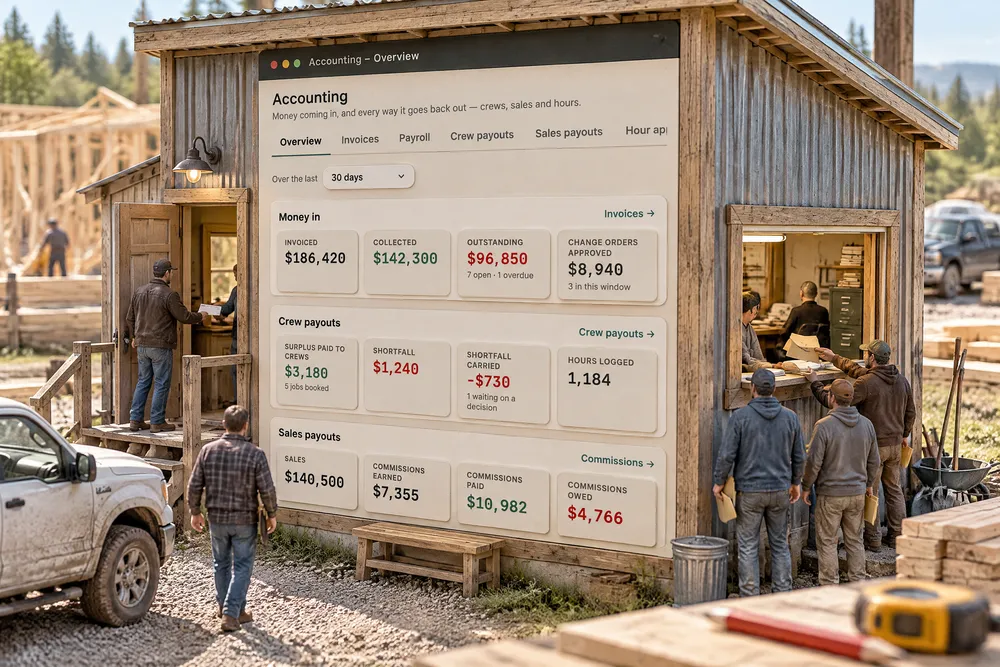
Accounting is where the money is. Overview totals what was invoiced, collected and is still outstanding; what the crews were paid in surplus and what shortfall they're carrying; and what the sales team sold and is still owed. Invoices is the invoicing you already know. Payroll pays everyone on the team and keeps each position's raise path, with raises that come due given there and back pay put on the next run. Crew payouts holds the company surplus ledger and the shortfalls waiting on a decision. Sales payouts is the commission ledger, which can credit a rep by itself when the customer signs. Hour approvals is where time, expenses and time off are approved. Accounts running more than one division can add Bills, Divisions and QuickBooks tabs. Each person sees only the tabs their role allows. And every job carries its own Budget & margin card, so you can see the money job by job as well as for the whole business. It's the money side of the operating system built exclusively for post-frame and barndominium builders — one place, instead of a payroll app, a commission spreadsheet and an invoicing tool taped together.
Also called: accounting tab · money in and money out · payouts · crew payouts · sales payouts · hour approvals · payroll · commissions owed · job budget · financials · money hub
One Overview for money in and money out
Try itThree sections, one window. Money in: invoiced, collected, outstanding and overdue, and approved change orders. Crew payouts: surplus paid to crews, shortfall, what crews are still carrying, hours logged. Sales payouts: sales, and commissions earned, paid and owed. Pick 30 days, 90 days or 12 months; what's true today — outstanding, carried, owed — stays put. Each section links to its tab.
Answering "how did last month go" meant opening four screens and adding them up by hand.
Owners lose sleep over what they can't see. One page that answers what came in and what went out gives back a feeling of control, and decisions get made on real numbers instead of that morning's bank balance. It's built exclusively for post-frame and barndominium builders, so it counts what they actually pay out: crews, reps and the job's changes.
Each role sees only its own tabs
Invoices for whoever can see invoices; Payroll and Crew payouts for whoever manages pay or approves hours; Sales payouts for admins and sales managers; Hour approvals for admins and project managers; Bills, Divisions and QuickBooks, where an account has them, for admins, project managers and sales managers. A sales rep sees the Overview and Invoices, and only money in. A tab you're not allowed is not there, and its numbers are left out of your Overview — the figures are added up on the server for the person asking.
One money screen for everyone is one screen that shows a project manager the commissions.
People work best when they're trusted with what they need and spared what they don't. Keeping pay and commissions private heads off the comparisons that sour a small team — and the owner can hand off approvals without a second thought.
Invoices: what the business is owed
The Invoices tab is Invoicing: invoices built from the estimate and the payment schedule, sent as a link, payments recorded however they arrived, and corrections that leave a record. Every invoice is grouped by job with what's paid and what's still due. If your books live in QuickBooks, QuickBooks Online keeps them matched.
Invoices kept apart from the rest of the money mean the owner checks two places to know where he stands.
Chasing money is the part of the job most builders hate. When what's owed sits on the same tab as what's going out, it's harder to put off the awkward call — and cash comes in sooner.
Approved change orders count as money in
Every approved change order counts on the Overview the week it's approved — and on the job it raises the revised contract on the Budget & margin card, so the extra work is billed and its cost is budgeted. A change order only reads Paid once every invoice it produced has cleared.
A verbal change is extra work nobody bills; a signed one that never reaches the books is the same thing with paperwork.
Customers accept a change more easily when it's written down and priced, and crews stop doing favours that never get paid for. For the business, every extra hammer swing has a line on the ledger.
Payroll for every role, in the same place
Try itThe Payroll tab pays everyone — crew, crew leads, sales, office, owners — from the hours approved here. Each pay run is one period: approved hours with overtime, salaries, commissions owed, approved time off, and any back pay or step bonus from a raise given on the Progression tab, worked out to the cent with what each person costs you. Progression shows everyone by position on their raise path, with the steps that have come due waiting for Give raise or Decline. It calculates; you or your payroll service pay and file. The whole of it is on Payroll.
Payroll in a separate product means retyping the hours and commissions this one already knows.
Payday is when trust is won or lost. Running it from the same hours and commissions everyone already sees means fewer surprises on a check — and an owner who isn't dreading Friday.
Crew payouts: the shortfall waiting on you
Try itFor crews on hourly pay with a shared surplus, every finished job books its result. Crew payouts puts any shortfall waiting on a decision at the top — who carries it, the crew or the company, and why — then each crew's jobs, surplus earned and paid out, shortfall, what the company absorbed, and the crew balance.
A job that ran a day long cost money somewhere, and without a decision nobody can say whose it was.
Crews accept a shortfall when it's clearly theirs and resent it when it isn't — late trusses aren't their fault. Making it a decision, with a reason written down, keeps the surplus fair, and a fair bonus is one the crew keeps chasing.
Labour cost by crew, below the ledger
Under the ledger, hours and labour cost for every crew: the days each crew worked priced at its own rates, what they were paid, and the gap between them. Crews on day rates with shared surplus are priced the same way, so every crew reads on one table.
Labour cost scattered across timesheets is the cost nobody adds up until the year is over.
Crew leaders take pride in a crew that delivers; seeing their days against their pay gives that pride a number. For the owner, it's the clearest early warning that a crew needs help.
Sales payouts: commissions earned, paid and owed
Try itSales payouts is the commission ledger: totals, each rep's default rate, what they've sold, what's owed and what's paid, then every sale with its rate and status. Switch on Credit the rep when the customer signs and a signed contract adds its sale for the rep on the pipeline card, at their default rate, once per contract. Commissions are worked out once, in cents; a rate change applies to new sales only, and a paid commission is voided, never quietly edited. Sales managers can read it; reps can't.
Commissions kept in a spreadsheet get a formula overwritten, and the rep finds out before the owner does.
A rep who trusts the commission math stops keeping his own spreadsheet and goes back to selling. For the owner, no more end-of-month arguments about what was agreed on which job.
Paying a run settles the commissions it carried
Try itWhen a pay run is approved, its hours lock — and so do the progression back pay and step bonuses it picked up; void the run and they're freed for the next one. When it's marked paid, the commissions it carried are marked paid in Sales payouts and the PTO people earned is added to their balances — one step, so the ledger and the payroll can't disagree about what's been paid.
Commissions paid through payroll but still marked owed in a spreadsheet get paid twice, or argued about once.
Reps relax when the ledger shows the same thing their check did. One step for both means the office never has to reconcile two lists, and nobody gets paid twice.
Hour approvals: one inbox for time, expenses and time off
Timesheets and expenses from the crews and subs, and time-off requests, land in Hour approvals, grouped by job. Under each job's name its hours are split — Job 62h · Drive 0h · Office / Shop 0h — and every line names who logged it and the stage, by the job's own stage name. Approve them one at a time or a whole job at once. Only approved time reaches the pay runs and the job's labour cost, and approving is limited to admins and project managers. Drive and shop hours are explained on crew time categories.
Hours approved by whoever happened to be logged in are hours nobody really checked.
Crews want to know their hours were seen and accepted, not lost in a pile. A clear inbox gets them approved quickly, and the owner knows every hour that's paid was checked by someone allowed to check it.
Every job's budget and margin, while it's running
Try itOn each job, the Budget & margin card shows the contract, approved changes and the revised contract, what's been invoiced and collected, then cost by phase: budget, committed (what purchase orders promised), actual (materials delivered, labour at what people are paid, approved expenses), projected and variance — and the projected margin. Closed, its tags still say it: margin, phases over budget, what's not billed yet. More on job profit, estimate against actual.
Most builders find out whether a job made money when the last invoice is paid — far too late to fix the phase that ran over.
Knowing a job is slipping while there's still time to act turns worry into a plan. The owner sees the problem at the roof stage instead of at tax time, and the project manager can fix it without being blamed after the fact.
Bills, Divisions and QuickBooks, for a company with more than one division
Try itAn account that runs an in-house division — HVAC, dirt work — beside the building business can switch on three more tabs. Bills holds outside subcontractor bills and every payment against them, kept the same here and in QuickBooks; recording a payment never sends money, and it only reaches QuickBooks once it's marked sent. Divisions shows each division's margin on the work it agreed to price, and the company's margin with the internal price left out. QuickBooks says who posts what, whether the sync is healthy and what needs a look. The Overview adds Money out — sub bills and Divisions sections. Only admins, project managers and sales managers see them, and an account that hasn't switched them on sees no change. More on vendor bills synced with QuickBooks and internal division commitments.
When a sub's bill is paid in QuickBooks and tracked somewhere else too, the two balances drift and nobody is sure what's still owed.
One bill balance, the same in both places, is one less thing to reconcile at month end. And a division that prices work to the builder needs its own margin, without that internal price being counted as a sale.
- 1Open Accounting from the menu. Old invoicing links land on its Invoices tab.
- 2Overview shows money in, crew payouts and sales payouts for the last 30 days, 90 days or 12 months; each section links to its tab.
- 3Invoices bills from the estimate and the payment schedule; Payroll works out pay for every role from approved hours, and its Progression tab shows who has a raise due.
- 4Crew payouts shows each crew's surplus and shortfall and anything waiting on a decision; Sales payouts is the commission ledger, with a switch that credits the rep when the customer signs.
- 5Hour approvals is the inbox for time, expenses and time off.
- 6On each job, the Budget & margin card compares cost by phase against the budget and projects what the job will make.
- 7Tabs your role can't use aren't there, and their numbers are left out of your Overview.
- 8Accounts running more than one division can switch on Bills, Divisions and QuickBooks tabs — shown to admins, project managers and sales managers: outside sub bills synced both ways, each division's margin against its agreed prices, and who posts what to QuickBooks. The Overview then adds Money out — sub bills and Divisions sections.
Money had spread across the app by accident of history: invoices under their own tab, commissions in the sales pipeline, crew pay in settings, hour approvals in the team screens — and payroll, for most builders, in a different product altogether. Every one of those screens worked; what was missing was one place to answer what came in and what went out. So Team stays where people are managed, Project Management stays where a job is watched, and Accounting is where the money is: each screen moved under one roof, payroll built in beside them, and an Overview that adds them up. The Overview's figures are put together on the server for the person asking and only carry the sections their role may see, so it can be shown to a project manager without showing him the commissions. And because a business-wide number can't tell you which job is leaking, every job got its own Budget & margin card: what was promised, what's committed, what's spent, and what the job will likely make — while there's still time to act on it.
- Invoices, payroll, crew pay and commissions scattered across different screens and tools
- No single view of what came in and what went out
- Pay figures shown to people whose role should not see them
- A job's margin only known after the job is finished